Background
Graphite was developed to combine academic text with interactive elements, data and sources in a digital publication. It supports standalone publications and publication series based on starter packs.
Role and approach
Graphite was conceived, designed, and developed as an open-source project. The approach translates academic publications into a multi-layered digital format that combines linear text with interaction, visualisations, data, and sources.
Contributors
Deliverables and result
Graphite was published as open-source software with source code and documentation. The publications linked below show concrete applications.
Selected publications




Concept
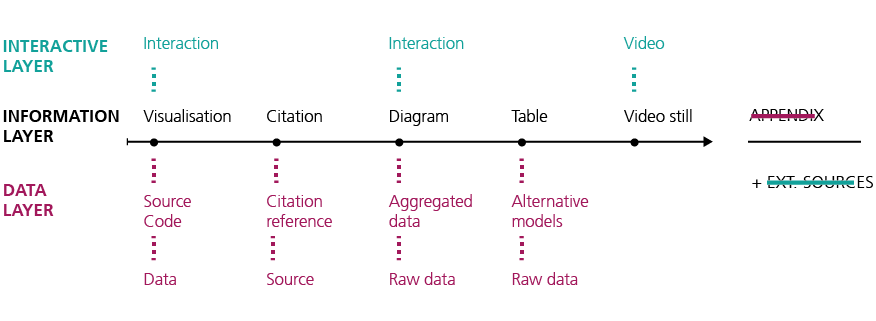
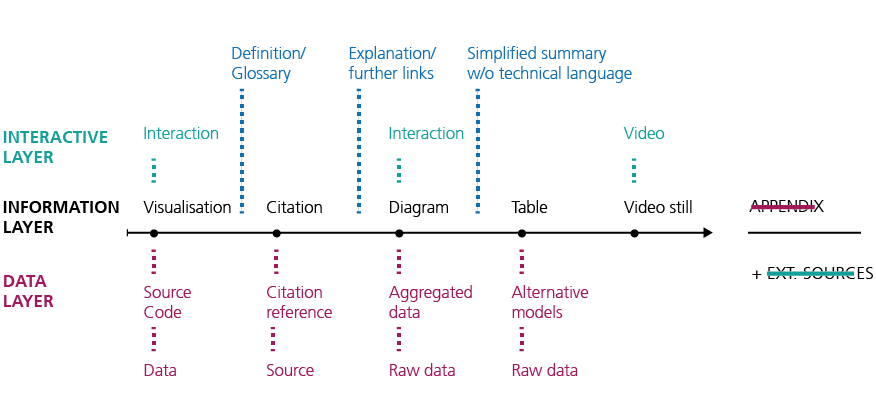
Graphite extends the linear structure of an academic article with interactive elements and supplementary material:
- The information layer contains the article's main text, references and appendix.
- The interactive layer adds elements such as videos, interactive visualisations and sortable tables.
- The data layer links to datasets, code, metadata and source information. Providing code and data can support attempts to reproduce the reported results.
Authors can also add glossary entries, explanations, specialist details or simplified summaries to address readers with different levels of prior knowledge.
Publications about Graphite
Hebing, M., Wunderlich, L., & Ebert, J. (2017). Rethinking Academic Publications: Developing an open-source framework for a multi-layer narrative in online publishing. xCoAx Proceedings of the conference on Computation, Communication, Aesthetics & X, 2017, 29--36. Publication details
Hebing, M., Wunderlich, L., & Ebert, J. (2017). Form follows function? Challenging the academic narrative. Digital Society Blog. Visit publication
Ebert, J., Wunderlich, L., & Hebing, M. (2017). Data, Information, Interaction. A multi-layer approach in online publishing. Digital Society Blog. Visit publication
Open Source
Graphite is published as open-source software: